


Nous avons tous vécu ce moment plusieurs fois : les cheveux viennent d’être lavés—encore mouillés, et vous êtes devant le miroir à essayer de décider « et maintenant ? » Vous voulez de la douceur sans lourdeur, de l’hydratation sans gras, de la douceur mais sans perdre votre texture naturelle. C’est là que l’après-shampoing sans rinçage fait le meilleur travail.

Que fait réellement un après-shampoing sans rinçage ?
Contrairement aux après-shampoings à rincer, un après-shampoing sans rinçage reste dans les cheveux pour continuer à agir bien après le jour du lavage. Considérez-le comme un soin capillaire continu plutôt qu'un traitement ponctuel. Il aide à :
-
Maintenir un niveau d'hydratation stable tout au long de la journée
-
Réduire les frottements et la casse lors du coiffage
-
Conditionner et adoucir les cheveux
-
Sceller la cuticule des cheveux pour un aspect plus brillant
-
Protéger les cheveux contre le stress environnemental, la chaleur et la sécheresse
Bien appliqué, la présence de l'après-shampoing sans rinçage dans les cheveux ne devrait pas être évidente. Il ne doit pas rester en surface ni alourdir les cheveux. Au contraire, vos cheveux devraient se sentir plus naturels : simplement plus calmes, plus doux et plus faciles à coiffer.
=== contenu divisé ===
Comment utiliser un après-shampoing sans rinçage (étape par étape)
La façon dont vous appliquez votre après-shampoing sans rinçage est aussi importante que le choix du produit. Voici une technique simple adaptée à la plupart des types de cheveux.
1. Commencez avec des cheveux propres et humides
Les après-shampoings sans rinçage sont plus efficaces sur cheveux fraîchement lavés. Pressez légèrement vos cheveux pour éliminer l'excès d'eau. Il est acceptable que vos cheveux restent relativement humides, mais ne les laissez pas goutter.
2. Le sectionnement est votre meilleur allié
Vous obtenez de meilleurs résultats lorsque vous ne l'appliquez pas seulement sur la couche supérieure. Divisez les cheveux en deux ou quatre sections, afin de garantir que chaque mèche reçoive une quantité égale de soin.
3. Utilisez moins que ce que vous pensez
C'est là que beaucoup se trompent. Les après-shampoings sans rinçage peuvent être assez denses, et en utiliser trop peut alourdir ou provoquer des accumulations. Commencez par une petite quantité, environ la taille d'un pois à une pièce pour les cheveux fins, un peu plus pour les cheveux plus épais ou plus longs.
Vous pouvez toujours en ajouter davantage si nécessaire, mais il est plus difficile de corriger une sur-application.
4. Concentrez-vous sur les mi-longueurs et les pointes
Le produit doit d'abord être frotté entre vos paumes, puis appliqué délicatement sur les cheveux, aux mi-longueurs et aux pointes. Ces parties des cheveux sont les plus anciennes, les plus sèches et les plus susceptibles d'être abîmées. Il vaut mieux ne pas appliquer de leave-in sur les racines, sauf si votre cuir chevelu est exceptionnellement sec.
5. Démêlez doucement
C’est le bon moment pour démêler. Un peigne à dents larges ou simplement vos doigts peuvent être utilisés pour cette étape, en commençant par les pointes et en remontant. Un bon après-shampoing démêlant sans rinçage permettra d’enlever les nœuds sans tirer ni casser les cheveux.
6. Coiffez comme d’habitude
Une fois appliqué, c’est à vous de décider si vous laissez vos cheveux sécher à l’air libre, les séchez au sèche-cheveux ou les coiffez comme d’habitude. Un après-shampoing sans rinçage ne remplace pas les produits coiffants mais les soutient en améliorant la condition et la réactivité des cheveux.
Choisir le meilleur après-shampoing sans rinçage pour votre type de cheveux
Les besoins en hydratation et en soutien de la texture varient considérablement selon les types de cheveux. La clé pour obtenir de très bons résultats est d’utiliser la bonne formule qui correspond aux caractéristiques naturelles de vos cheveux.
Meilleur après-shampoing sans rinçage pour cheveux fins
La plus grande peur pour ceux qui ont les cheveux fins est l’aspect « plat ». Vous voulez la brillance et la santé, mais vous ne voulez pas perdre votre volume.
-
La technique : Vous avez besoin d’une formule en spray. Vaporisez d’abord le produit sur vos mains, puis peignez légèrement vos doigts dans le tiers inférieur de vos cheveux. Cela vous donne un contrôle total sur la quantité.
-
Le choix GK Hair : Spray Leave-In GK Hair. C’est un changement radical pour les cheveux fins. Il est infusé avec Juvexin V2 (un mélange de protéines kératiniques véganes) et des extraits naturels de céréales. Il offre cet effet conditionnant essentiel sans alourdir, laissant vos cheveux rebondissants et légers.
Après-shampoing sans rinçage pour cheveux bouclés
Les cheveux bouclés sont naturellement plus poreux et sujets à la sécheresse car les huiles naturelles du cuir chevelu ont plus de difficulté à descendre le long des "spirales" de la tige capillaire. Pour vous, l’après-shampoing sans rinçage n’est pas seulement une option, c’est une nécessité.
-
La technique : Utilisez la méthode des "mains en prière". Prenez une petite quantité de crème, frottez-la entre vos mains et appliquez-la sur vos boucles pour sceller la cuticule. Ensuite, essayez de froisser doucement vos cheveux vers le haut pour faire ressortir votre motif naturel de boucles.
-
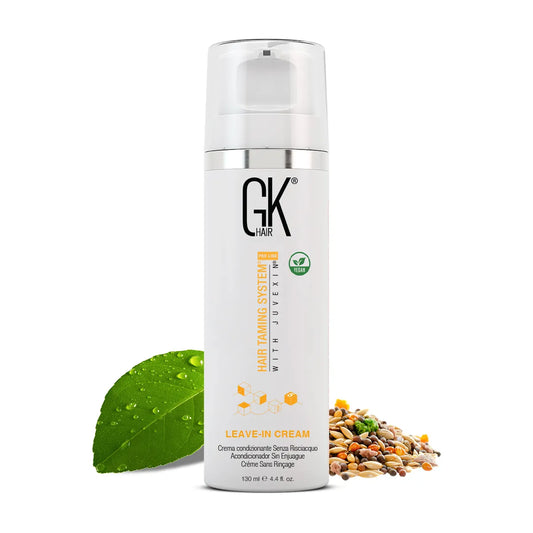
Le choix GK Hair : Crème Leave-In Conditioner GK Hair. C’est le meilleur après-shampoing sans rinçage pour cheveux bouclés de notre arsenal. C’est une formule riche et nourrissante qui hydrate profondément vos cheveux. D’une part, le Juvexin V2 renforce vos boucles de l’intérieur, tandis que d’autre part, les huiles naturelles de graines éloignent les frisottis même dans les conditions les plus humides.

Après-shampoing démêlant sans rinçage pour cheveux secs et abîmés
Vos cheveux peuvent devenir « croustillants » ou fragiles si vous utilisez souvent des outils chauffants ou si vous avez récemment changé de couleur.
-
La technique : N'hésitez pas à en utiliser un peu plus si nécessaire. Appliquez votre crème leave-in sur cheveux humides, et si vos pointes sont particulièrement sèches, vous pouvez en appliquer un peu sur cheveux secs entre les lavages pour « rafraîchir » l'hydratation.
-
Le choix GK Hair : Pour les cheveux épais ou abîmés, GK Hair Leave-In Conditioner Hair Cream est votre ancre. Cependant, si vous cherchez un coup de boost supplémentaire en brillance et protection, superposer quelques gouttes de GK Hair Argan Oil Serum sur le leave-in peut tout sceller magnifiquement.

Vous avez les cheveux secs et frisottis et vous n'êtes toujours pas sûr qu'un après-shampoing sans rinçage vous convienne ? Découvrez notre analyse d'expert dans : Le meilleur après-shampoing sans rinçage pour cheveux secs et frisottis : un guide expert des formules, ingrédients et meilleurs choix.
Le bon moment pour utiliser un après-shampoing sans rinçage
La plupart des gens bénéficient de l'utilisation d'un après-shampoing sans rinçage après chaque lavage. Si vous lavez vos cheveux deux à trois fois par semaine, utilisez-le après chaque lavage. Une petite quantité peut également être utilisée sur des cheveux très secs ou texturés entre les lavages pour rafraîchir les pointes.
Habituellement, si vos cheveux semblent lourds ou enduits, cela indique que vous utilisez trop de produit plutôt que de l'utiliser trop souvent. Changez la quantité, pas la fréquence.
Questions populaires
-
Ai-je encore besoin d'un après-shampoing classique ? Dans la plupart des cas, oui. Un après-shampoing à rincer élimine l'excès de saleté et d'huiles qui se trouvent sur la couche la plus externe juste après l'utilisation du shampoing. Le leave-in est votre soin « longue durée ». Tout comme pour une routine de soins de la peau, le rinçage est votre nettoyant/neutralisant, et le leave-in est l'hydratant.
-
Est-il acceptable de l'appliquer sur cheveux secs ? Les cheveux humides sont la norme idéale pour l'absorption ; cependant, vous pouvez certainement appliquer une petite quantité de produit sur cheveux secs pour éliminer les frisottis ou apporter un peu de brillance avant de sortir.
Tout réunir
Utiliser un après-shampoing sans rinçage sur vos cheveux ne consiste pas à ajouter une étape difficile de plus à votre routine quotidienne. Il s'agit plutôt d'offrir à vos cheveux le soin continu dont ils ont besoin pour rester équilibrés, faciles à coiffer et en bonne santé jusqu'à votre prochain lavage.
Pour découvrir plus de produits spécialement conçus pour la structure, la texture et la résistance naturelles de vos cheveux, consultez la gamme complète de produits GK Hair.



Laisser un commentaire